May 23, 2025 | Mark Goldstein |
- Introduction
- Ease of Use
- Image Quality
- Sample Images
- Product Images
- Rating & Conclusion
- Main Rivals
- Review Roundup
- Specifications
- Comments (1)
Latest Reviews
Introduction
The Canon EOS R50 V is a new entry-level mirrorless camera aimed at content creators who want to upgrade from their smartphone, compact camera or DSLR to a more capable device.
It is a video-first camera designed for for vloggers, streamers, and influencers that want high-quality footage with the minimum of fuss.
It offers 4K/60p recording (cropped to 64% of the horizontal area) oversampled from 6K and Full HD footage at frame rates up to 120p in 4:2:2 10-bit quality.
There’s also Canon Log 3 for greater flexibility in post-production colour grading, custom colour profiles, 4-channel audio, and a vertical tripod mount. The LIVE button allows you to quickly access your streaming options, and go live within seconds.
It has a 24.2 megapixel APS-C CMOS sensor which is partnered with the very latest Digic X processor.
12fps burst shooting is available when using the R50 V’s first-curtain electronic shutter and 15fps when using the silent electronic shutter, both with continuous auto-focus and auto-exposure.
The native ISO range runs from 100-3200, which can be expanded to ISO 51200, and the top shutter speed is 1/8000sec.
Thanks to its Digic X processor and Dual Pixel CMOS AF II autofocus system, the EOS R50 V offers the same deep-learning artificial intelligence based automatic face, eye, animal and vehicle AF tracking modes as the full-frame R3, R5 and R6 and the APS-C R10 models.
The Canon R50 V features a 3-inch 1,040K dot resolution LCD vari-angle monitor with a touch-screen interface. There is no viewfinder on this model.
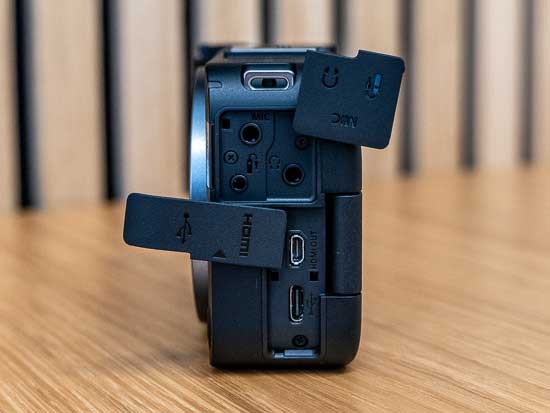
There’s also a UHS-II SD memory card slot, built-in Wi-Fi and Bluetooth connectivity, USB 3.2 Type-C connector, micro-HDMI port, microphone and headphone ports and the latest multi-function accessory shoe.
The Canon EOS R50 V is available in black only priced at £729.99 / €829.99 / $649.99 body only in the UK, Europe and USA respectively, £959.99 / €1,099.99 / $849.99 with the RF-S 14-30mm F4-6.3 IS STM PZ kit lens, and £999.99 / €1,149.99 in a special Content Creator Kit. It is made in Japan.
Ease of Use
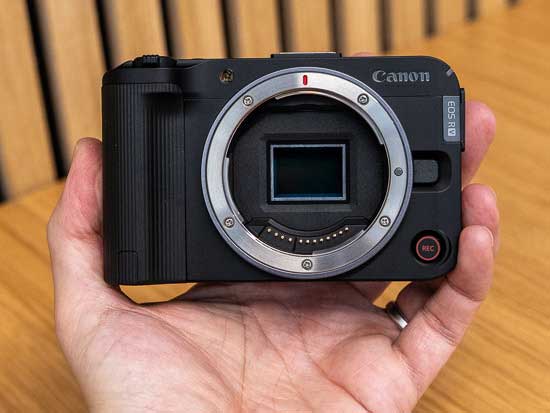
As its name suggests, the new EOS R50 V shares a lot if its core DNA with the EOS R50 model that was released in 2023 – it just takes a different, more video-focused approach in terms of its design and control layout.
It is still predominantly targeted at people who are either completely new to photography or those who have outgrown the capabilities of their smartphone or simpler compact camera, just more oriented towards recording video rather than capturing stills.
The Canon R50 V offers the ability to record up to 4K/60p video in 4:2:2 10-bit quality with dual-pixel auto-focus and auto-exposure for up to 2 hours, although at 60fps it is unfortunately cropped to 1.56x / 64% of the horizontal area which gives a frame similar to Super 35mm. Also note that while 4K/30p is oversampled from 6K, 4K/60p isn’t.
Full 1080 slow-motion recording at up to 120p with autofocus is also available (but no sound), which is actually something that even the flagship EOS R5 doesn’t offer.
Both live streaming on YouTube and vertical video capture are supported, the latter being ideal for reels and stories. Canon have also included zebra display during movie shooting, which can be used as a guide to exposure adjustment, especially for highlights.
Inherited from the R50 is a rather Sony-inspired video shooting mode called “Movie for close-up demos”, which as the name suggests can be used to automatically focus on anything that you hold up to the camera during recording, and then focus back on the subject when the object is removed from the frame or moved backwards.
The R50 V supports Movie Digital Image Stabilisation (IS), an extra Digital IS mode called Enhanced which helps to keep handheld footage sharp. Note that it achieves this by applying a crop that’s even more aggressive than the one applied in the normal Digital IS mode, so you’ll ideally need a wide-angle lens to use it.
New video-centric features on the R50 V which aren’t on the original R50 include Canon Log 3 for greater flexibility in post-production colour grading as well as Canon709, Cinema Gamut and HLG profiles, a headphone jack that allows you to monitor the audio, and a dedicated vertical tripod mount on the side of the camera that’s in addition to the one on the bottom.
Joining the the R50, R10 and R7 models, the EOS R50 V is the fourth Canon APS-C crop sensor mirrorless camera to use the same RF lens mount as the company’s full frame cameras.
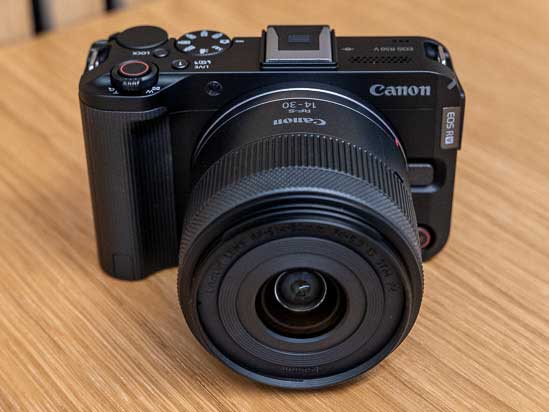
You can use Canon’s relatively new range of RF-S lenses which are designed specifically for the R50, R50 V, R10 and R7 (and all future Canon R-series APS-C cameras). This includes the new RF-S 14-30mm F4-6.3 IS STM PZ kit lens that ships in a bundle with the R50 V.
Or you can use the more established full-frame RF lenses, with an accompanying change in the focal length due to the 1.6x crop factor involved with mounting full-frame lenses on an APS-C sensor.
In addition, Canon’s huge number of EF and EF-S DSLR lenses can also be used with the R50 V and R7 by attaching the optional EF-EOS R Mount Adapter, which is very handy if you already have a large collection of legacy lenses.
The 24.2 megapixel sensor in the Canon EOS R50 V is a re-engineered version of a sensor design that has previously been used in many Canon models, including the Canon EOS M50 Mark II, the Canon EOS 850D and the Canon EOS R10. It’s also exactly the same as the sensor inside the R50.
Commendably the R50 V benefits from using the latest and greatest Digic X processor, just like the more expensive R10 step-up model.
The ISO range for stills runs from 100-32,000, which can be further expanded up to ISO 51,200, exactly the same as the EOS R50. For video it goes up to ISO 12,800, expandable to ISO 25,600.
The EOS R50 V is the latest Canon camera to support Dual Pixel RAW. This allows correction of the focus and contrast in the background using the Background Clarity mode and changing the lighting in portraits via the Portrait Relighting mode after capture, just using your finger/thumb on the EOS R50 V’s touchscreen LCD.
Somewhat amazingly at this price point, the Canon R50 V features exactly the same next-generation Dual Pixel CMOS AF II focusing system as used by the flagship R3 and R5 full-frame cameras and its EOS R50, R10 and R7 APS-C siblings.
It has 651 automatic focus points and 4,503 manually selectable AF points, 100% frame coverage in Auto selection mode and 90% vertical and 100% horizontal in manual selection.
Impressively the EOS R50 V can focus in light levels as low as -5EV (when used with an F1.2 lens) or with maximum apertures as small as f/22, which enables autofocus even when using ultra telephoto lenses with teleconverters.
Shutter speeds as fast as 1/4000s are supported using the mechanical shutter and up to 1/8000s using the electronic shutter, which is slightly slower than the 1/16,000s speed offered by the R10.
Thanks to its Digic X processor, the EOS R50 V offers exactly the same deep-learning artificial intelligence based automatic face, eye and animal AF tracking modes as the R3, R5, R6, R7, R10 and R50 models.
The Canon R50 V can recognise and track eyes, and it works even if the person is wearing a mask, helmet or sunglasses. Subject tracking works for humans and also dogs, cats and birds, the latter even in flight.
The EOS R50 V also has the ability to track vehicles, including cars and motorbikes. What’s more, if the driver is wearing a helmet, the AF system will lock on to that, ensuring that the most important subject is in focus.
Turning to the R50 V’s continuous shooting speeds, the camera can shoot at a fast 15fps for 95 JPEG / 36 RAW images when taking advantage of the silent electronic shutter, complete with full AF and AE tracking, which is 8fps slower than the R10 camera (23fps). Slightly slower 12fps burst shooting is available when using the R50 V’s mechanical shutter/1st curtain electronic shutter which is maintained for 140 JPEG / 59 RAW images.
The R50 V’s buffer compares badly to the Canon R10, which allows bursts of up to 460 JPEG or 29 RAW images when using the mechanical shutter at 15fps and 70 JPEG or 21 RAW images when using the electronic shutter at 23fps, but it it a lot better than the R50 thanks to the new UHS-II card support.
Note that the R50 V features a mechanical shutter. However, like the R50, it is electronic first curtain only which allows stills to be captured without rolling shutter artifacts.
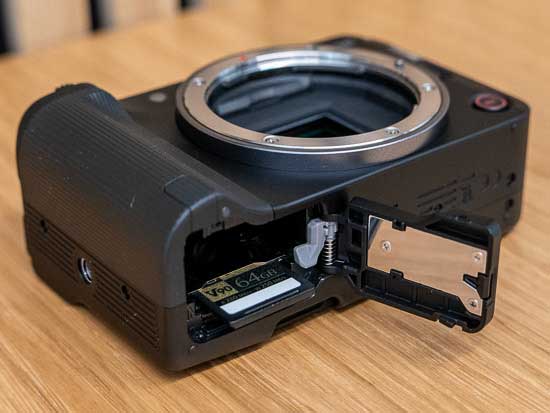
The R50 V camera only has a single, rather out-dated UHS-I SD card slot that’s rather inconveniently housed in the same compartment as the battery, a direct consequence of the camera’s small, compact design.
Just like the R50, in-body image stabilisation is unfortunately not supported by the Canon R50 V. Instead you have to rely on a mix of lens stabilisation (if the lens offers it) and/or in-camera digital stabilisation.
The R50 V is Canon’s latest EOS camera to support the ‘next generation’ HEIF (High Efficiency Image File) file format, enabling images with 10-bits of data to be saved in a file the equivalent size of a JPEG, while suffering less compression.
RAW files can be shot in tandem with JPEGs (or indeed HEIF files) as per usual – here with Canon’s own .CR3 (Canon Raw) file extension, which requires the likes of Photoshop or Lightroom to access and open.
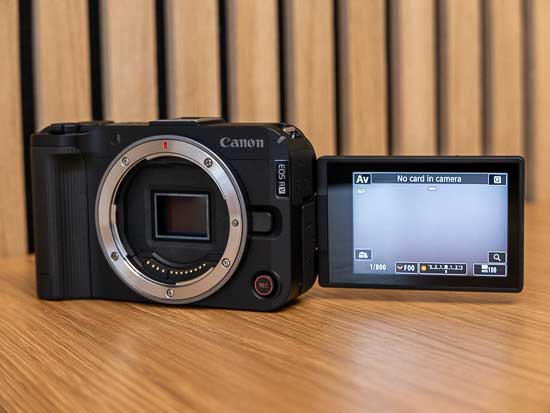
The EOS R50 V has a largely plastic body rather than the more substantial mixed polycarbonate/magnesium-alloy body used by the more expensive R7.
The R50 V doesn’t offer any level of weather-proofing, so you’ll need to jump to the R7 if you need this feature. Note that all the RF-S zoom lenses released to date are also similarly not weather-proof.
The R50 V measures 119.3 x 73.7 x 45.2mm and weighs in at 370g with both a battery and memory card fitted, making it quite a lot smaller than the Canon R50 (116.3 x 85.5 x 68.8mm) but only 5g lighter despite not having a viewfinder.
Due to rather its diminutive stature, the Canon R50 V suffers from having a rather shallow handgrip, but unlike the R50 it does at least comfortably accomodate three fingers. It’s also finished a nice tactile rubberized material that further aids grip.
There is one prominent control found on the R50 V’s minimalist front plate, joining a porthole for the AF assist light and a lozenge shaped button for releasing the lens. This is a brand new REC one-touch movie record button which makes it much easier to record yourself than having a button on top of the camera.
Also new for the front of the EOS R50 V is a tally lamp in the top-right corner which lights up red when recording which is a very useful addition.
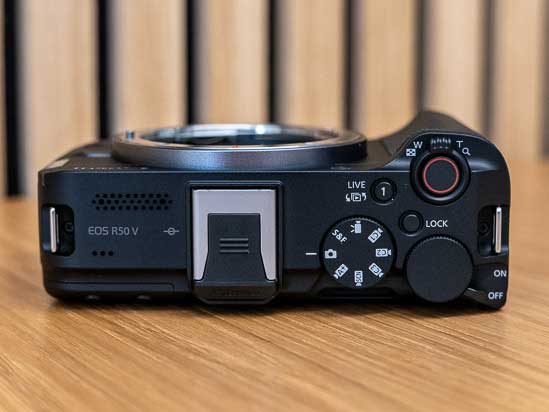
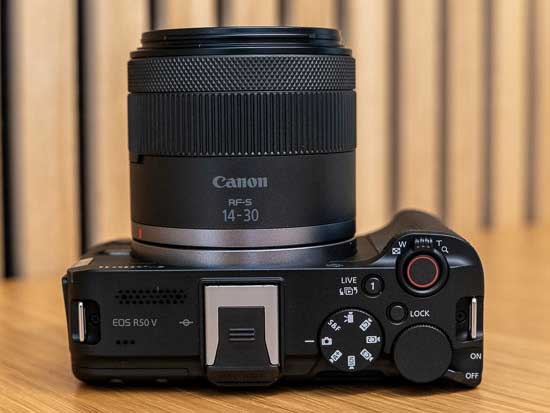
On top of this camera is a conventional shooting mode dial on the right-hand side to change the shooting mode, but unlike the R50 the focus here is very much on video rather than stills, which are relegated to a single position.
The usual P, Tv, Av and M options are still available, but you have to delve into the menu system to select them, joined by the Bulb and Scene Intelligent Auto modes plus six different scene modes.
Instead there are seven different video shooting modes on the dial, which include Slow&Fast, movies, C1, C2 and C3, movie scenes (smooth skin movie, movie for close-up demos, movie IS mode) and movie auto.
There’s a small On/Off switch over on the far-right, with the camera leaping into life almost instantly. The camera intelligently remembers separate settings for each of the movie and various stills settings.
There’s a second responsive video record button at the top of the handgrip which doubles up as the shutter release for stills, with a new wide/tele power zoom toggle switch encircling it which works in tandem with any PZ lens including the new 14-30mm that was sent to us for review.
The Multi-Function Shoe on top of the camera provides data communication and power for accessories such as the ST-E10 Speedlite Transmitter, DM-E1D Stereo Microphone, and AD-P1 Smartphone Link Adapter, as well as acting as a traditional hotshoe for existing Speedlites and triggers via the AD-E1 Multi-Function Shoe Adapter.
Unlike the R50 model, Canon have not included a handy built-in flash on the R50 V.
Completing the top of the R50 V are two new buttons, one for instant live streaming and the other for locking the camera’s current settings. There is no ISO button as found on the R50, again reflecting the video-centric focus of this model, while the control dial has been moved to the rear falling more naturally underneath your thumb.
The R50 V doesn’t have either a second control dial or an AF joystick, as on the EOS R10, which reflects the fact that this particular model is targeted more at beginners and smartphone users.
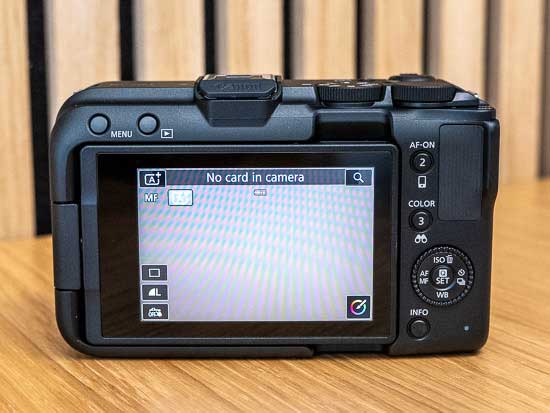
Turning to the rear of the camera, there are Menu and Playback buttons located above the LCD screen, with all the other controls over on the right-hand side.
Next to the rather slim thumb-grip are the AF-On button and a Color button for for quick access to various video gammas, above a spinning dial which has specific functions at left, right, up, down and the Q/Set button in the centre which opens the Quick Control screen and provides instant access to 10 key camera controls.. The Info button is below this dial.
The 0.39 inch, 2.36 million dot EVF on the EOS R50 V isn’t the most